
The Penguin Test
What a viral meme reveals about the divide between pessimists and optimists—and why I'm choosing the mountains

Every week, 114 readers get my latest Wonderings & Wanderings on life, culture, politics, and whatever else I’m thinking about. Subscribe below to join them (and make me look a little less like a struggling blogger).
Hey everyone! No matter where you were this weekend (besides in Australia, where they’re playing the Australian Open in 100 degree heat), I’m sure you did your best to stay warm during one of the biggest cold fronts ever experienced this century. While I mostly stayed inside to watch who would be making this year’s Super Bowl on Sunday, I did take advantage of the snow here in NYC and decided to try to make some ice cream in my backyard (it was more like soup, but still really good).
The ice on the sidewalks, robbing me of my balance for the next week, won’t be fun, but as someone who rarely saw snow growing up, I absolutely love it when it happens. Speaking of cold weather, I’m not sure about y’all, but there has been one meme and one meme only that has absolutely flooded my algorithms, and I can’t get it off my feed cause I like each and every video of it that pops up: the penguin that heads for the mountains. Just to show you what my feed looks like, here’s proof of what my X account showed on Friday:
Now, as you can tell from some of the tweets above, there was some online discourse about the penguin, which (bear with me here) cuts at a much deeper issue in our society, in my opinion: broad cultural splits fueled by the widening gap between two factions of the country. So in today’s blog, I will first explain the origins of the meme and the two sides that have formed around it. Then I will discuss the broader cultural splits that mirror what we see from the reaction to the penguin, and then finally explain what side of the debate I land on, and why I believe it is the better side to be on. So grab your jacket, snow boots, and a cup of hot chocolate. To the mountains we head, let’s dive into the blog.
The Penguin Meme that Divided the Internet
While I’m sure many of y’all reading this are familiar with the video I am talking about, I want to make sure that everyone reading this knows what I am talking about, as it might start getting very confusing very quickly. The video first appeared on TikTok (which I don’t have, just doing my due diligence) in mid-January.
 Tiktok failed to load.
Enable 3rd party cookies or use another browser
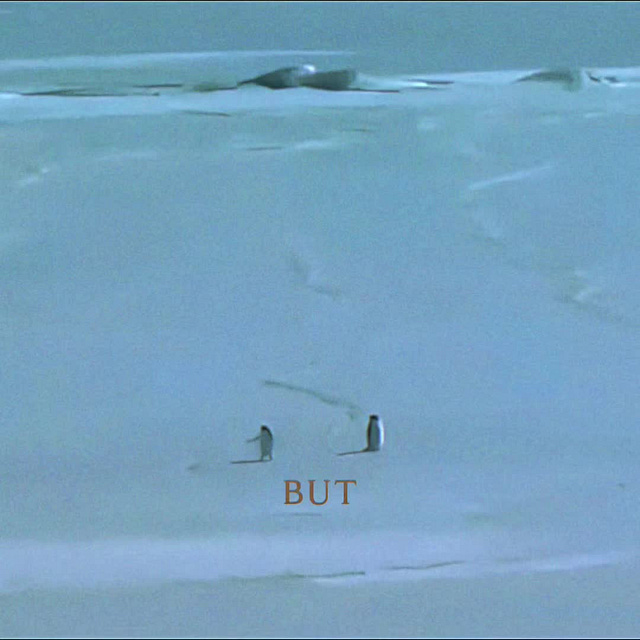
The video comes from world-renowned filmmaker Werner Herzog from his 2007 documentary Encounters at the End of the World, which captures footage of people and animals working and living in Antarctica. While there are many cool parts of the film, the clip of the penguin became the most famous, with Herzog’s narration as follows:
“These penguins are all heading to the open water to the right. But one of them caught our eye—the one in the center. He would neither go towards the feeding grounds at the edge of the ice, nor return to the colony. Shortly afterwards, we saw him heading straight towards the mountains, some 70 kilometres away. Dr. Ainley explained that even if he caught him and brought him back to the colony, he would immediately head right back for the mountains. But why?”
There’s a great breakdown of the clip/meme’s history here. Still, TLDR, it originally surfaced on YouTube in 2008, went viral again on YouTube in 2015 with the title of “The Nihilist Penguin”, briefly reemerged on social in 2023-2024, before becoming the super mainstream version we see today, where the video combines a pipe organ cover (awesome video btw) of Gigi D’Agostino’s EDM classic L’Amour Toujours. As opposed to the nihilistic view of the penguin a decade prior, the current meme of the penguin is mostly one of optimism, hope, and striving for greatness. Here are some of my favorite memes about the post that I’ve come across (and this is probably less than 5% of all the ones I’ve seen):


While it was not the intention, the meme ended up functioning as a cultural Rorschach test. One side took a very pessimistic view of the approach, while others (basically every meme that has been on my feed) took the optimistic view.
The pessimistic reading of the penguin, like the originally famous nihilistic interpretation of it, sees it as a symbol of existential dread, depression, and the absurdity of existence, possibly due to the repetitive cycle of survival where the penguins swim to the feeding grounds, go back to the colony, mate, and then repeat the cycle. In this view, the penguin has given up on society and chosen oblivion due to life feeling futile and all paths being meaningless.
 Tiktok failed to load.
Enable 3rd party cookies or use another browser
The optimistic view reframes the penguin as an explorer. Someone who rejects conformity and chooses their own path, even if it is unconventional or dangerous. In this frame, the penguin is exercising radical freedom by defying its own biological instinct & the herd and opting to venture to the mountains, which represent the unknown, the search for something more meaningful. The penguin might die, but it will do so on its own terms, having chosen a different way rather than blindly following the colony. Many compared the idea behind this penguin to Friedrich Nietzsche’s Übermensch, prompting one of my favorite new terms coined regarding this meme.
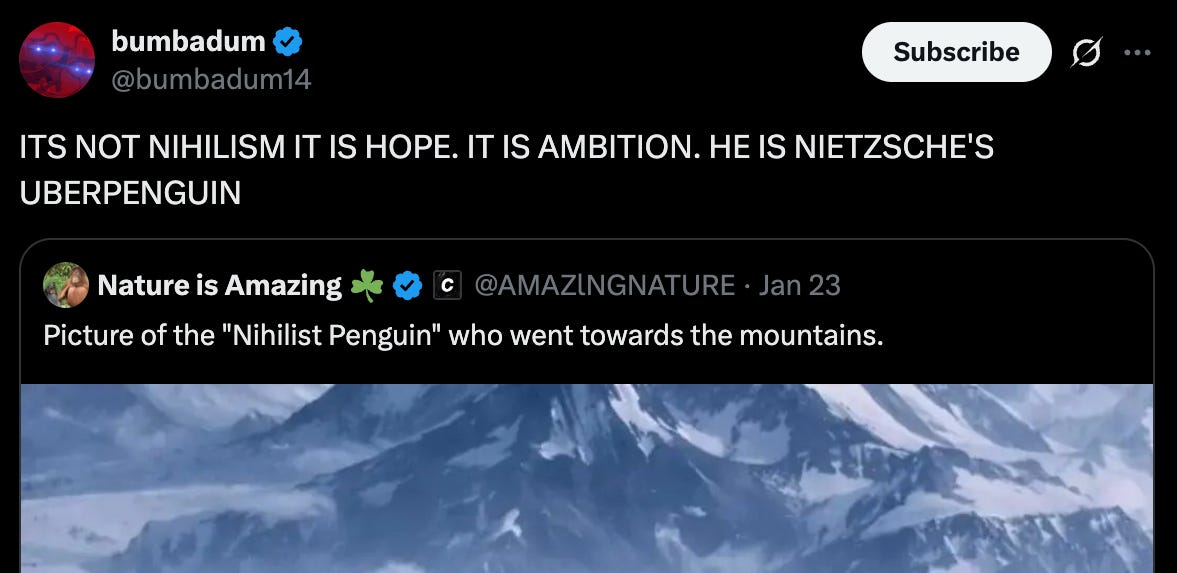
This situation is very similar to the dichotomy found in the critically acclaimed Everything Everywhere All at Once, with the two different perspectives of the idea that “nothing matters” (which I’ve written about previously - shameless plug still going strong). Getting back to the penguin, I saw many tweets that delved into deep philosophical discussions about the two different interpretations of the penguin (such as this one, or one that says the penguin is more human than any Redditor, or the thin line between depression and Faustian spirit). This has shown me that the penguin discourse isn't just about a penguin. It's a proxy for a much larger divide we see in our society today.
Same Evidence, Different Conclusions
One of the most talked-about topics of the last decade in terms of cultural discourse has centered on the political divide in the country. So I don’t want to bore you with that (although I do think there’s some overlap, but I digress), and instead focus on another divide occurring in our country between the pessimists and the optimists. Between those who see one thing as dangerous and others who see the exact same thing as progress. The two most glaring and obvious issues where we see this divide between pessimists and optimists (in my opinion) come from two of the most talked about technologies today: AI and Nuclear.
AI: Doomers vs. Believers
Perhaps no contemporary divide illustrates this split more starkly than the artificial intelligence debate. In the AI pessimist camp, you have figures like Eliezer Yudkowsky, who says if anyone builds artificial superintelligence, then everyone on earth will die as a result, and that pausing developments is not enough; we need to shut it all down. Yudkowsky, along with other like-minded critics, focuses his core argument on the idea that there is an alignment problem between what is good for humanity and what is theoretically good for a superintelligent AI. Due to this, in their minds, we shouldn’t try to pursue this technology at all.
On the flip side, you have the AI optimists, such as Marc Andreessen, who, in his Techno-Optimist Manifesto, argues that there is no problem created by nature or technology that more technology cannot solve, including using AI to help solve these problems. Additionally, he believes that decelerating AI development will have an opportunity cost of many lives. He, along with other AI optimists, sees AI not as the greatest risk, but as the greatest hope for the future of humanity.
So…that begs the following questions: Will AI take away jobs or make everyone better at their jobs? Will AI remove life’s meaning through work, or will it give us more time to do the things we enjoy? Will AI destroy us all, or help us build a prosperous future for all of humanity? It’s a little confusing, to say the least.
Nuclear: Catastrophe or Clean Energy
Nuclear is in a very similar predicament. The Bulletin of the Atomic Scientists even acknowledged this in their 81st volume, published this past December, stating that
“Discussion about nuclear energy has long been marked by extreme polarization, with proponents and opponents seeming to inhabit separate worlds when making wildly different claims about the future of nuclear energy. In making these claims, proponents and opponents do not engage with one another, hoping to learn; rather, they try to evangelize, seeking to convince the other side of what they view as universal truths about nuclear energy.”
The anti-nuclear side of the aisle, which includes the Sierra Club, Greenpeace, and Friends of the Earth, argues that the safety risks of nuclear are way too extreme and worries about how this technology spreading globally, will also come with a proliferation of nuclear weapons across the globe. They frequently point to the examples of Three Mile Island, Chernobyl, and Fukushima to back their points.
The pro-nuclear side, which includes the Abundance Institute (check them out, they’re awesome), American Nuclear Society, and Mothers for Nuclear (gotta be my favorite one), sees nuclear as the energy source of the future for all of humanity. In fact, whereas the anti-nuclear contingent sees Fukushima & Three Mile Island as disasters, the pro-nuclear group may frame them as success stories since there were no immediate radiation deaths as a result of either instance, and at most one long-term radiation death from Fukushima.
These are just two specific examples amongst many others, but in all these cases, the same problem persists: both sides imply that their arguments are meant to be universal. But why does that happen? Why does it seem so hard for two opposing factions to come to an understanding with one another?
First and most obviously, there is the negativity bias that we humans inherently possess. Theories suggest that we evolved with this bias to gain an adaptive advantage, prioritizing the detection of threats and losses, which is critical for survival. However, in today’s world, where our problems are no longer focused on survival since we’ve essentially solved that issue (shameless blog plug as always), we shift our attention more towards social, identity, and existential problems. So instead of honing our bias on threats to survival, we focus it on threats to our beliefs, such as our view of the world. Thus, some people will see these opposing views and view them as threats and will thus oppose them even more staunchly.
The modern media apparatus, including social media, exacerbates this problem as its whole business model runs on getting likes, clicks, and other user actions, and studies have shown that negativity will produce more of it. A 2023 study titled Negativity Drives Online News Consumption showed how each additional negative word increased click-through rates by 2.3% while positive words decreased clicks by 1%. Since these algorithms know what we like and don’t like so well, this means we will specifically come across posts and articles along the lines of “Dangerous new AI tool to give users more power than ever” or “Anti-nuclear lunatics want to shut down reactor”, thus having us see the opposing view as threatening to us. The more one leans into this negativity bias, the deeper one falls into their prescribed echo chamber, and thus makes it more difficult to even acknowledge the other side’s point.
So now comes the part where you, the reader, might want to do some thinking and figure out which camp you fall into: the pessimistic one or the optimistic one. I'll be the first to admit that the pessimists often sound smarter, and research and famous anecdotes back this. A study by Harvard professor Teresa Amabile found that those publishing negative book reviews were perceived as more intelligent than those giving positive reviews, and well-known philosopher and economist John Stuart Mill famously said:
“I have observed that not the man who hopes, when others despair, but the man who despairs when others hope, is admired by a large class of persons as a sage.”
But sounding smart and being right are two different things. And when you look at the data, on health, on achievement, on quality of life, the optimists aren't just happier. They're winning. So, for the last section of the blog, I want to give you my reasoning why I chose optimism.
Choosing the Mountains—The Case for Optimism
Just recently, at the all-important, but sometimes absolutely laughable, World Economic Forum, one of my favorite quote providers ever, Elon Musk, ended his talk with the following line:
“For quality of life, it is better to err on the side of being an optimist and wrong, rather than a pessimist and right.”
At first glance, it’s easy to view this remark as being nonsensical. I mean, who would rather be wrong than right? However, when you really focus on the quality of life, being an optimist provides much more value than being a pessimist for a multitude of reasons. I’ll break down why scientifically, philosophically, and practically.
The Science: Optimists Live Longer
Being optimistic is not just some feel-good disposition that is hard to prove; it is measurably correlated with better outcomes across health, longevity, and performance. Let’s start with simply surviving. A meta-analysis of 15 studies and over 225k participants published in 2019 found that optimism was associated with a 35% lower risk of cardiovascular events and a 14% lower risk of all-cause mortality. Additionally, research from Lewina Lee at Harvard showed that optimists tend to live 11% to 15% longer than pessimists and have an excellent chance of achieving exceptional longevity (i.e. an age of over 85 years). And it’s not due to an optimistic mindset providing some supernatural longevity increases; it actually helps people’s immune systems function better, as shown in a study back in 2009.
Optimism doesn’t just help survival, though; it also leads to better performance and achievement. A famous study done by Martin Seligman on MetLife insurance agents showed that two years after hiring, the optimistic employees had sold 31% more life insurance than their pessimistic counterparts, and even that employees who failed the aptitude test but scored well on the optimism test did 57% better than the pessimists (i.e. optimism helped more than selling proficiency). Additionally, a Forbes study showed that these upbeat types are 103% more inspired to give their best effort at work, which helps push them to be more likely to be promoted, more engaged in their work, and feel less burned out.
The Philosophy: Meaning in the Mountains
One of my favorite books that I read last year was Viktor Frankl’s Man’s Search for Meaning, which has become one of the most important philosophical books of the modern era. One of the core takeaways from the book that was added in the book’s 1984 postscript was the idea of tragic optimism, which he defined:
“I speak of a tragic optimism, that is, an optimism in the face of tragedy and in view of the human potential which at its best always allows for: (1) turning suffering into a human achievement and accomplishment; (2) deriving from guilt the opportunity to change oneself for the better; and (3) deriving from life’s transitoriness an incentive to take responsible action.”
The key difference here is that Frankl rejected “artificial” optimism, which is a type of optimism that is forced onto oneself by ignoring all the negatives and harboring false illusions. Frankl’s optimism was grounded in realism, but he observed that those who survived the Nazi concentration camps tended to embody this type of tragic optimism, and those who perished typically did not. It was hope and meaning that kept people alive.
Aside from Frankl’s book, just think about the philosophical choice of how you interpret the penguin. As shown by the two opposing views, Herzog’s penguin has no objective meaning. Thus, we project onto it instead, but the projection we choose shapes how we act. And choosing the optimistic view is much more appealing than the pessimistic one because in this view, we believe the penguin exercises radical freedom by choosing its own path rather than believing the penguin is doing it to end its meaningless existence. As French philosopher Albert Camus once said, “One must imagine Sisyphus happy.”
The Practical: History Rewards the Believers
Lastly, there’s a practical reason why you should choose optimism - history tends to reward those who are optimistic. While the pessimist may sound smart, it’s the people who bet on progress, innovation, and human ingenuity that build wealth and shape the future.

The S&P 500 chart is a decent proxy for this, as it’s basically a bet that the best companies in the world will continue to grow and prosper in the future. The more you zoom out, the clearer it becomes that even in the biggest downturns (2008 financial crisis, Dot Com bubble, etc.), the bet has paid off. You can even just look at the odds that the index will be positive over the course of a month, year, three years, etc., and see that it has quite an impressive hit rate.
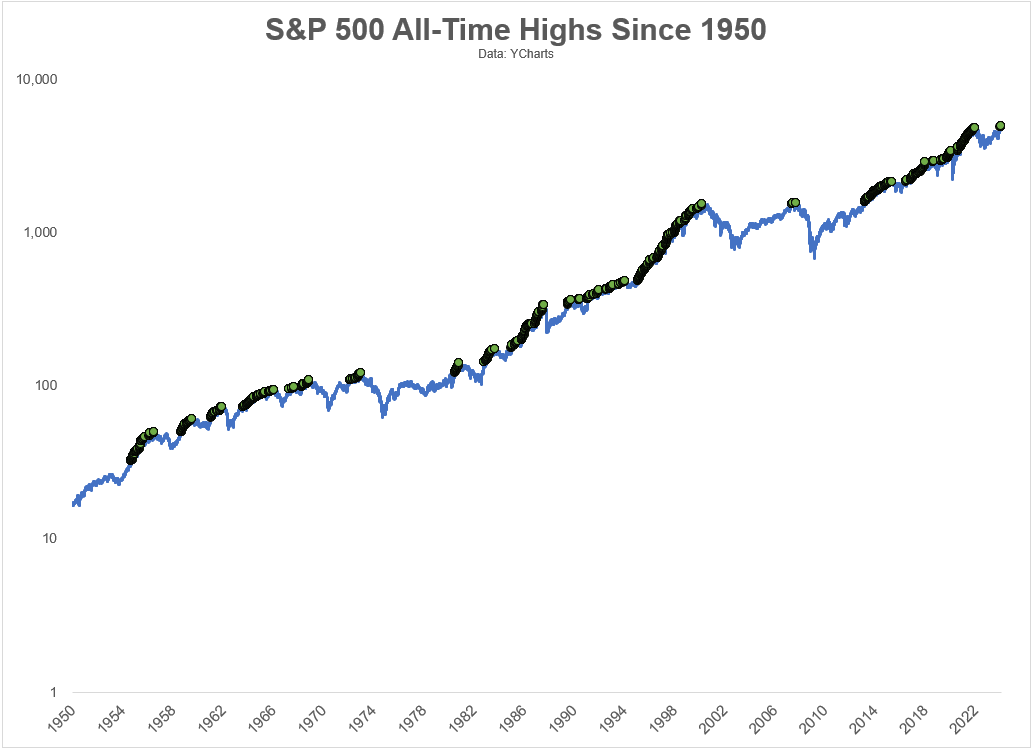
Set aside the market as a whole and think about specific companies. All of them were once a bet against the odds that many “smart” people probably dismissed at the time. How many people thought Tesla's electric cars were ridiculous, or that a few guys in a garage making Apple computers was a joke, or building a website to help college kids interact—Facebook—was pointless? Optimists build things, and pessimists critique them, and the practical reality is that progress is created by people who see possibility where others see risk. The market's long-term trajectory reflects a collective bet on optimism. And those who bet against it? Their track record speaks for itself.
Lastly, I will admit that sometimes they are indeed right. Take Michael Burry, from The Big Short (one of my all-time favorite movies, btw), Peter Schiff, and Nouriel Roubini, who all predicted the 2008 financial crisis and made an absolute killing off of that. However, since then, they have notoriously and consistently been wrong in predicting the next collapse. As some would say, they have predicted roughly 10 of the last 1 recessions. Looking at the outcome of some of their more recent calls, their track record has suffered, and if you had instead just invested $10k in the S&P 500 back at the end of 2008 and ignored their calls, you’d now have over $104k.
Conclusion
In the end, Herzog’s lone penguin waddling toward the mountains isn’t just a meme; it’s a mirror reflecting our own choices in a divided world. Whether we see it as a tragic wanderer lost to despair or a bold explorer chasing the unknown, the interpretation we choose shapes not only our view of progress in AI, nuclear energy, and beyond, but our very quality of life. History, science, and philosophy all point to the same truth: optimism isn’t naive ignorance; it’s the engine of human achievement, turning potential threats into triumphs and suffering into meaning. So, as the cold winds of uncertainty (and New York right now) blow, let’s err on the side of hope, strap on our metaphorical snow boots, and head for the mountains, because the view from the top is always worth the climb.
Thanks for reading! I will admit that the penguin is one of my favorite memes of all time, so allowing some of my “research” for this blog to be just scrolling my Instagram and X was pretty fun. Not sure what I will be writing about next, but until then, I hope you have a great time exploring whatever your mountain is.
Here’s where you can find me/contact me: