
Escape Velocity
AI has crossed the point of no return. Here's what that means and what to do about it.

Every week, 115 readers get my latest Wonderings & Wanderings on life, culture, politics, and whatever else I’m thinking about. Subscribe below to join them (and make me look a little less like a struggling blogger).
Hey everyone! I hope y’all have had an amazing week thus far! There have been a few big events since my last blog, so let’s get up to speed real quick. It’s a common phrase for people to say, “This is my Super Bowl,” when referencing a specific thrill, TV show, party, or anything they are personally excited about that equates that moment to the “big game” in their life. However, as someone told me recently, the Super Bowl is my Super Bowl. Thus, you best believe I watched the whole thing from beginning to end without taking my eyes off the screen. The first thing I’ll say is congrats to the Seattle Seahawks, and what an absolutely incredible defensive performance. The Seahawks were arguably the least talked-about best team in the league with one of the best defenses ever, plus Sam Darnold's remarkable career comeback. While nothing seemed to go right for the Pats, they still had an amazing season, winning 17 games compared to four the previous season, a +13 game difference that I believe is the most of all time.
Additionally, I just got back from New Orleans and had an absolutely amazing Mardi Gras (as I always do). I have plenty of stories and memories from it that I plan to cherish for the next few months until I go back home, but my Mardi Gras was made when I got to meet one of the all-time heroes and role models of my life…Drew Brees:

I was able to keep my cool and not mumble my words (thankfully), but I am forever in debt to my friend who made me the glasses he’s wearing in the photo (you know who you are, and I owe you a million favors now). If you wanna hear more about my Mardi Gras, you’re just gonna have to join me on a bar crawl this weekend (SIGN UP IF YOU’RE IN NYC), but back to the Super Bowl, since it inspired me to write this blog.
Aside from the game itself, the lagniappe around the Super Bowl (the halftime show and commercials) had everyone tuned in. However, I want to focus on the ads, specifically regarding the sheer number of ads for AI companies (and others) this year:

If you read this blog, you’ll know that I like to keep up with everything AI (at least I think I try to). Because of this, I’ve had a good number of friends stir up some AI conversations with me about its capabilities, the implications, and what to do about it. From what I’ve gathered, there are still so many people who don’t understand what’s about to come. Especially in the last few months, there’s been an enormous amount of progress in the field, and I believe the inflection point has been crossed.

For today’s blog, I will discuss the current state of AI and why I think we’ve hit the inflection point (and why this “bubble” everyone talks about doesn’t matter), the implications of AI looking forward, and what you can/should do knowing it. So sit back, find a spot on your couch, and let’s dive into the blog.
The Inflection Point
As I mentioned, there have been a few of my friends who have brought up AI with me, and one of the things I always ask them is how they are currently using it. I mostly get answers saying how they use Microsoft CoPilot at work to summarize an email, or use ChatGPT to give them a recipe for a meal they want to cook, or they are making images or video memes to share (I’ve seen some great ones). While all of these use cases are nice to have, no one would consider these groundbreaking changes to our day-to-day lives (not to say having something that gives me a banana bread recipe isn’t groundbreaking). However, AI is far, far beyond this right now. Years ahead. Miles ahead. Pick your metaphor.
I’m nowhere near the frontier of building things using AI, but here’s just a list of things I’ve done so far (as someone who has only a beginner-level understanding of coding/software development):
A website for my croquet club (if you live in NYC, you should come in April!)
A tool to help write wedding speeches (very rough, but built the frame of what eventually became my recent wedding speech)
A website for a crawfish boil I’m hosting in NYC (won’t link it yet, stay tuned)
The company I showed this to in my interview must not have thought too highly of it (cause I didn’t get the job), but I thought it was pretty cool.
A few other projects on ideas I am working on in GitHub
So when I talk to people about AI, and they tell me they don’t really think it can do that much right now, I always immediately think of this meme:
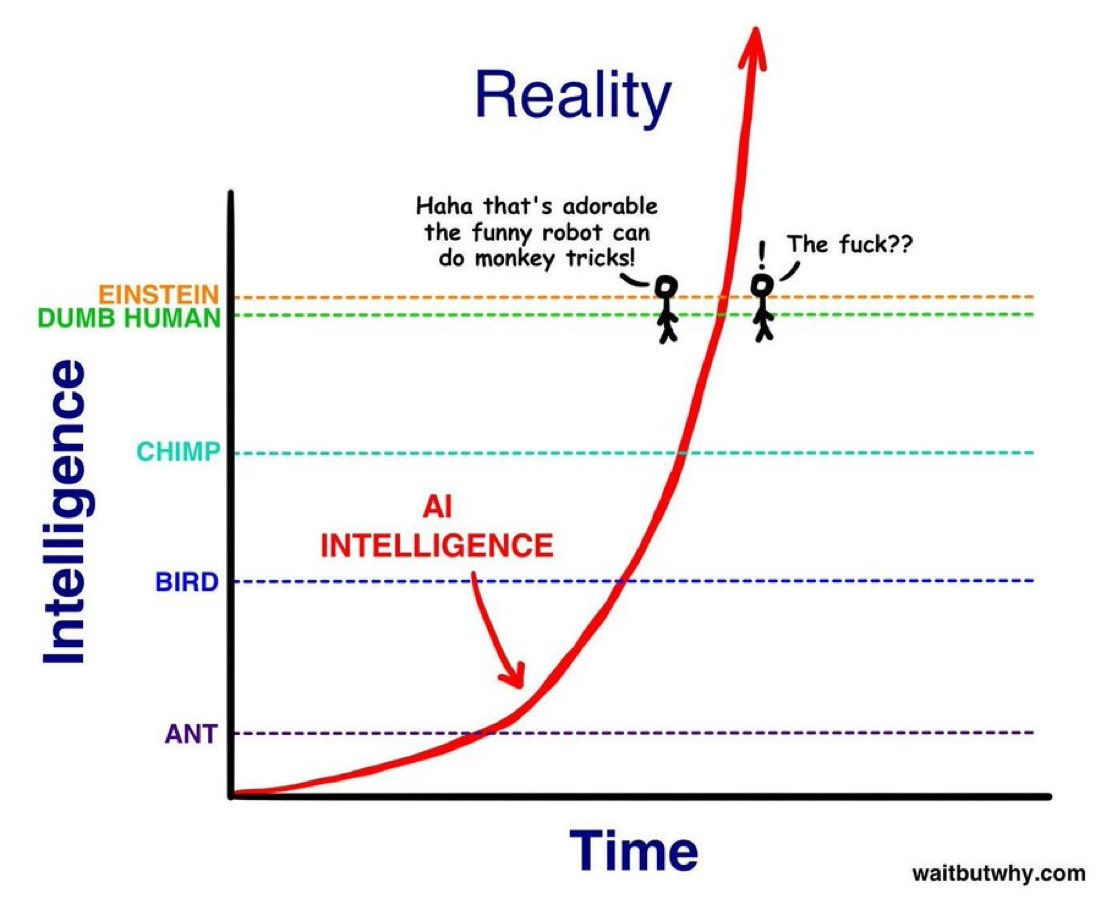
However, as I mentioned, I am nowhere close to being on the front lines of all this advancement. So if you don’t believe me, let’s just take a look at some of the news, headlines, and developments from the last few months.
First, Claude Code became the top AI coding tool (which is what I use), and the team internally at Anthropic has been using it so much that they built their new tool called Cowork entirely with Claude Code. This follows what Anthropic’s founder and CEO has been saying, “we might be 6-12 months away from models doing all of what software engineers do end-to-end.” Software engineers at Anthropic are even saying that they don’t write code anymore; they just have the AI write it for them.
The top companies pushing this forward are projecting $660 billion in capital expenditures this year on things like data centers, chips, and energy infrastructure. To understand the scale, just look at the breakdown below. It’s absolutely insane, like Manhattan Project levels.


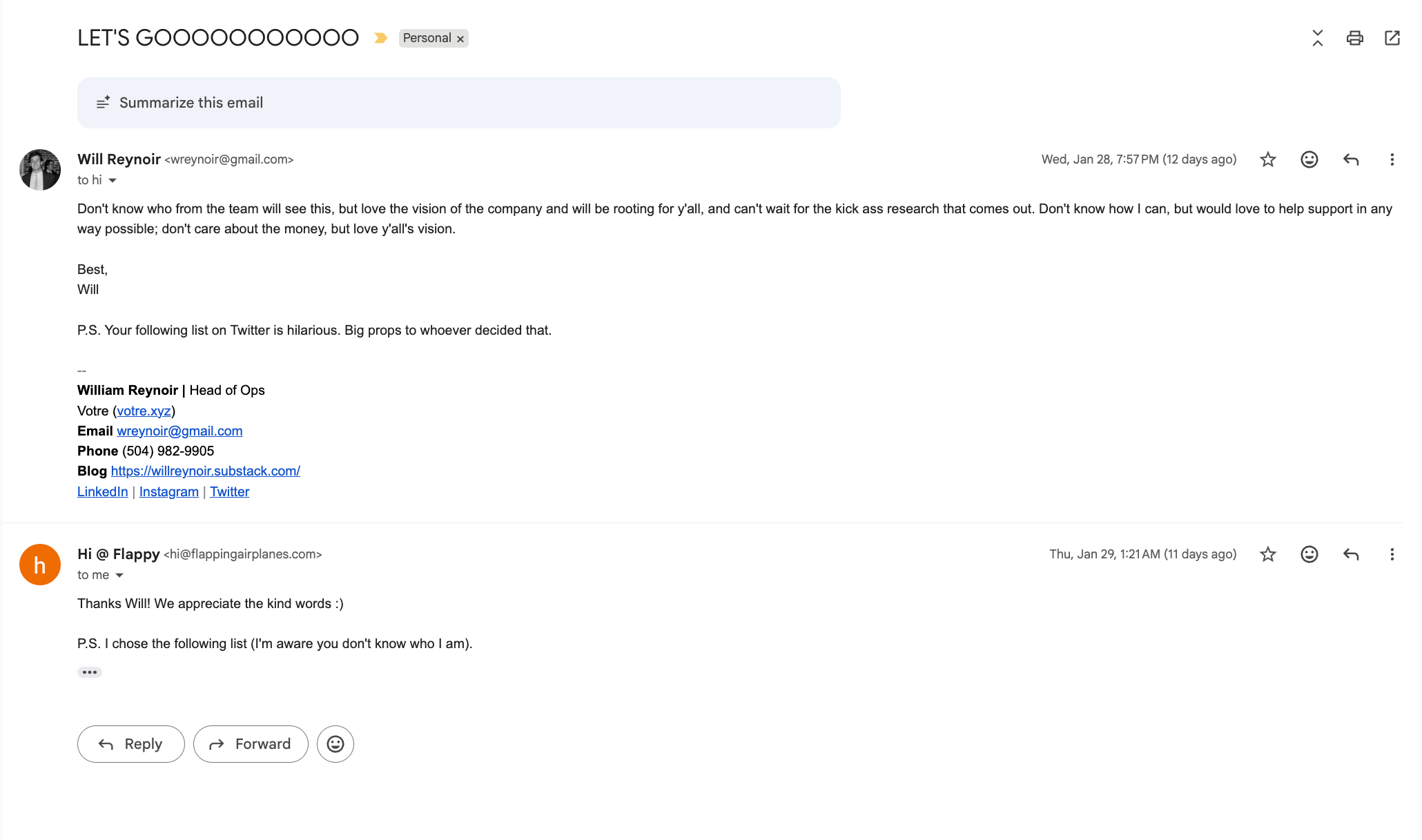
The CAPEX numbers are crazy, but fundraising numbers are equally as preposterous. The most obvious ones are all the frontier models and labs, such as Chat GPT with its $40B fundraising round, or Anthropic’s $30B round at a $380B valuation, or xAI’s $10B at a $200B valuation in September of last year, before they recently merged with SpaceX. However, there are some rounds at smaller companies that I would argue are even wilder. A company led by Mira Murati (previously at OpenAI) that was pre-revenue, 6 months old, and had not raised money previously (at least to my knowledge) was able to raise $2 billion at a $10 billion valuation. Hell, even a company called Flapping Airplanes, which said there are no commercial plans and is just doing research (for now), was able to raise $180 million. However, it’s safe to say I’m a fan of them based on their X account’s following tab and how they responded to my email.
And it’s not just these large companies that have shown to be making crazy progress; it’s also open source development as well. The biggest headline on this front has been OpenClaw (formerly MoltBot, and formerly before that ClawdBot). It’s an open-source autonomous AI agent that runs locally on your device and can integrate with LLMs like ChatGPT or Claude to execute real-world tasks via chat apps like Telegram, WhatsApp, or Discord. Your OpenClaw can then run 24/7 with full system access, and with its proactive automations and long-term memory, it can handle workflows like content creation or research completely independently. It’s like having an actual AI employee that does things for you completely and fully. Just search OpenClaw on X, and you’ll see some people building incredible things. I even have an OpenClaw set up myself, and while I’m still working on configuring it appropriately, Alfred, the name I gave my AI bot, is already helping with some of my to-do tasks.
Update: Since starting this blog, the founder of OpenClaw, Peter Steinberger, joined OpenAI to help drive the build-out of personal agents. Shows how fast this industry moves.
If you want to know what the best test is of how fast AI is developing, look no further than the incredibly robust and surely expert-approved “Will Smith eating spaghetti test”, or you can hear straight from an expert like Matt Shumer who recently published an article with his thoughts and insights from within the industry that implore that we’ve hit a turning point in just how good AI is.

With all the ads that appeared in the Super Bowl (i.e. these companies dropping the absolute bag), the most common critique I’ve heard from some of my friends is that they believe this is all just a bubble. My retort to that would be a few things. First, one of the biggest aspects of the internet infrastructure build-out was the installation of fiber cable. However, due to the excitement, a significant amount of fiber was laid out that ultimately went unused, as there was not enough demand. Thus, a bunch of companies that used debt and expected cash flows to follow this build-out got hit hard when the bill came due, since they hadn’t made the expected cash return. Compared to the “AI bubble”, data centers are the big infrastructure build-out, and they are being used to their full capacity. Each additional data center is making models smarter, which means they are able to complete more work, which will drive more productivity gains that businesses and users want access to. Secondly, the companies doing the spending now vs. the internet boom are profitable cash machines of the likes of Microsoft, Google, Amazon, and Meta. Thirdly, unlike the .com bubble, there are very few public companies that offer direct exposure to AI. The .com bubble had things like pets.com, Webvan, or eToys.com, which were IPOs that were trying to take advantage of the internet craze. Companies are choosing not to IPO as early today, so the risk of a mass selloff of equities and companies going belly up is much less likely.
Maybe I’m wrong about this, but bubble or not, the infrastructure is being built. The nuclear plants are being restarted. The engineers are saying they don’t write code anymore. The question isn’t whether AI is real at this point; it’s whether you’re positioned for what comes next.
What This Means
So if the inflection point is real, what actually changes? What’s important now is not to be upset about it all and wish that something that inevitably will happen doesn’t happen, but instead try to think about what the first, second, third, fourth, etc. order effects will be, looking forward and taking the necessary steps to prepare for them. Many people have been commenting on some of these implications (some much more qualified than I am), but here are some of my thoughts on the matter:
Meaning and Identity
Throughout human history, people were able to find meaning in work. Before more modern times, this meaning was derived from work providing the means to survive and create stable environments (i.e., farming, hunting, etc.), and more recently has also tackled these problems (getting enough money to purchase food), but also social, identity, and even existential problems (shameless plug from a previous blog). The literature shows that employment is a major source of identity for many people, such as a 2021 study titled Happiness, Work, and Identity. So what happens when AI handles most knowledge work? Historically, people have found new jobs after technological shifts (ex: farmers became tractor mechanics). But if that doesn’t happen this time, I see two paths.
The darker path is a mass wave of anxiety and existential dread as the thing that gave people purpose disappears. Basically, a bunch of people go through a midlife crisis all at once. The more positive outlook is that instead of people losing their meaning and acting negatively on that feeling, they shift the focus of their meaning to more worthwhile goals or pursuits. That could mean different things to different people. For me, it would be focusing more attention on the people in my life, like my friends and family, and spending more time with my future kids (as they are the main legacy 99.9% of people have in this world), but it could mean something completely different for others.
Shifting Back to Real Experiences
Brian Chesky attended the Masters of Scale Summit a few months ago and was asked several questions as part of a 30-minute panel. The part that went most viral, of course, was his discussion on AI. Here’s a quick excerpt of his talk:
His takeaway is that AI will dominate the world of screens, and because of that, more people will be yearning for in-person experiences and connections. I largely agree with this take. Increasingly, the content and even people you see online are AI-generated, and while some people will eat this up, many others will decide to log off and find more to do IRL. What does this mean? From a career perspective, companies will start hiring more roles targeting IRL experiences, even ones that you wouldn’t think would have these types of roles traditionally (look no further than Basic Capital’s Growth Manager, IRL position). Service companies will see more demand and thus, more job openings. Meanwhile, IRL-focused jobs with limited supply, like coaching, will become even more competitive to land (thankfully, I have open offers to go back to coaching if AI takes over).
Aside from the career implications, the social ones are interesting. I think many people will dive further into the terminally online world than they already are, sadly, as AI will be able to cater content even better to these people, but many will also find themselves interacting with their fellow humans more than they were before. Maybe this will mean more and more people will become members of the Central Park Croquet Club or join me for a bar crawl this weekend (Again…SIGN UP!).
Trust and Authenticity
Going off this last point, it’s going to become increasingly hard to determine what is real and what is not in the digital world. I previously talked about how authenticity is becoming a growing currency of politics (shameless plug again), but the growing use of AI will make authenticity valuable in many more domains.
The best historical parallel I can think of is photography. When the camera was invented in the 1800s, many predicted it would kill painting. I mean, why pay an artist to create a portrait when a machine could capture reality perfectly? Instead, the opposite happened. Painting didn't die; it evolved and became more valuable precisely because it represented something a camera couldn't replicate: human interpretation, style, and vision. The Impressionists, Post-Impressionists, and eventually modern art all emerged after photography, not despite it. When perfect replication became possible, imperfect humanity became the differentiator.
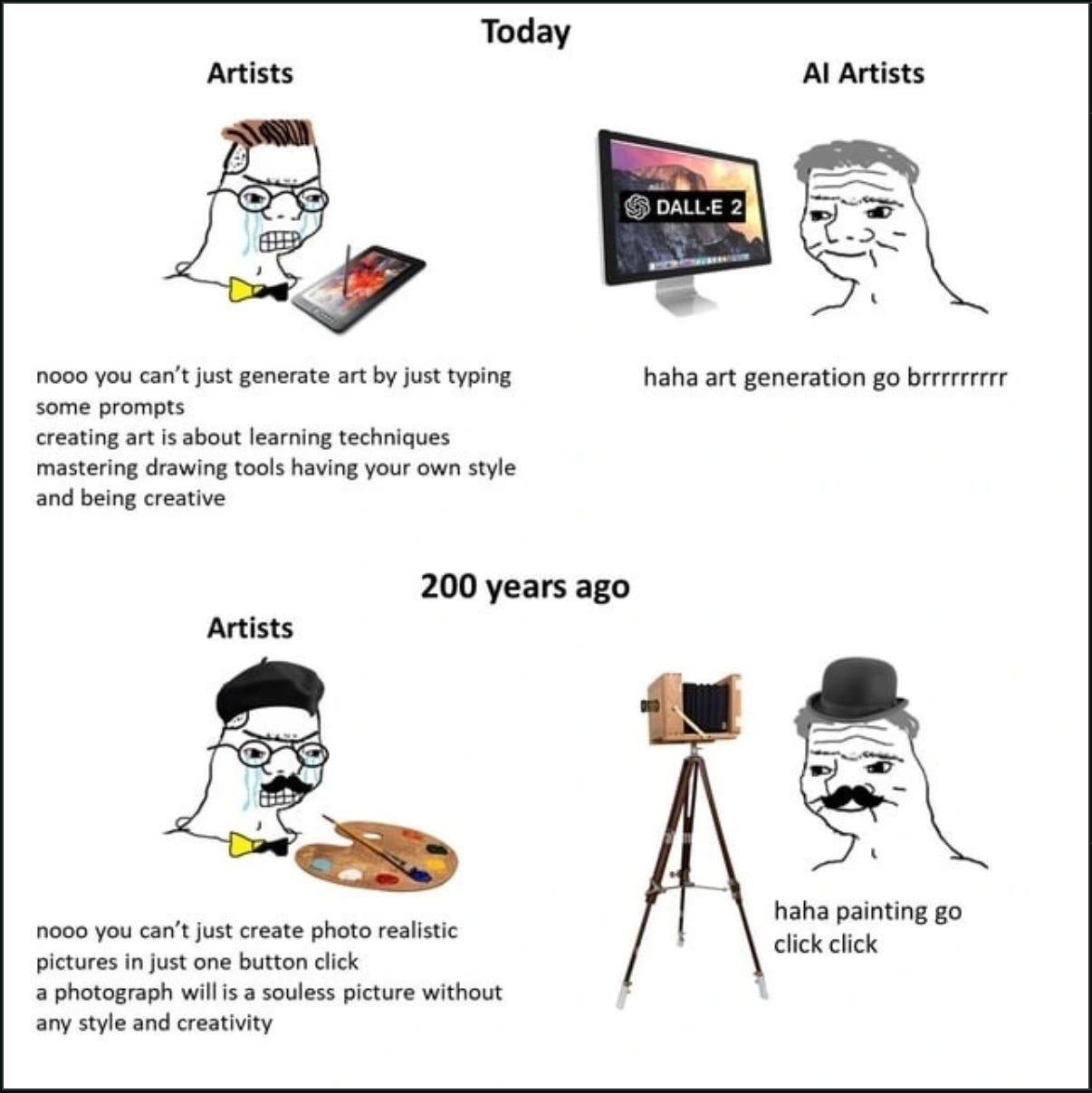
The same dynamic is about to play out with AI-generated content. When anyone can generate a polished blog post, a professional headshot, or a compelling video in seconds, the things that can't be easily generated become more valuable. What are those things? A track record built over years, a real name with a reputation attached to it, long-term relationships where people actually know you, and proof-of-work artifacts that show you've been in the arena. What does this mean practically? Building in public matters more than ever. The person who has been writing a newsletter for three years, even if it's imperfect, has something an AI-generated content farm never will: receipts. A verifiable history that can't be faked. The irony is that in a world of infinite AI-generated content, the most valuable thing might just be being undeniably, verifiably human, and having the track record to prove it.
Jobs & Companies
As I briefly mentioned in the Meaning & Identity section, jobs and companies will look much different in the next five years than they do today. Anthropic’s CEO Dario Amodei has publicly stated that he believes AI could wipe out up to 50% of entry-level white-collar jobs in as little as 1-5 years and push unemployment to 10-20% if unmanaged. At the same time, the companies that can integrate AI effectively will absolutely kill it in their earnings and be much more productive. Thus, if you can land yourself at one of these companies that could be heavily impacted by AI (such as software or finance), you can stand to gain a lot, as explained by PWC. How does one do that? Well, if AI is gonna create some of these changes, you learn how it works and how to implement it. The proof is in the pudding, as AI-skilled workers saw an average of 56% wage premium in 2024.
Companies will look much different as well. The clearest implication in my mind is that bigger behemoths will become leaner as AI shifts work from menial tasks to higher-level tasks, but what I think is much more interesting are companies on the smaller side. AI will significantly reduce the costs of companies and their products getting off the ground, as the productivity and revenue-per-employee numbers skyrocket. This means that a bunch of old ideas that were otherwise thought of as being impossible or stupid, or new ideas that are only possible with these newfound efficiencies, will be spawned. Thus, I believe more people will begin working for “startups” more than ever before, as more and more smaller companies can achieve what took larger companies and teams to accomplish previously. OpenAI’s most recent Super Bowl ad showed this in full display.
These are just a few of the many implications that will arise with the proliferation of AI. So, given all of this, what should you actually do?
What To Do
I’ve talked about things you can do to stand out and avoid being left behind in an AI world about six months ago in a different blog (third time’s a charm with the shameless plugs), but I want to do it a little differently this time. Instead of just providing high-level thoughts or specific tools you can use (many from the last blog still apply today), I want to give you some practical steps you can take, tiered by effort level. Let’s do the easiest one first.
Tier 1: Start Today (Low Effort, High Signal)
Estimated time: 5-30 minutes
The thing you can do right away is simply substitute your typical Google searches with AI search tools like Perplexity or just switch to Google’s AI Mode powered by its Gemini model. Google search has been the standard interface for the internet for two decades now, and the writing is on the wall that it won’t be how we interact with the internet in the future. Doing this will help you become accustomed to interacting with LLMs daily in a way that requires minimal effort and minimal change to your day-to-day activities.
I also recommend going on a walk and having a conversation using voice mode with ChatGPT, Claude, Grok, or Gemini on your phone about a topic you are knowledgeable in, curious about, or something you have no idea about. Doing this will demonstrate the power of these tools & their ability to interact with you, helping you become accustomed to working with AI to learn and eventually accomplish tasks. You can even try to ask some complex moral questions, like the ones below, that have spawned some of my favorite memes recently (besides the penguin, of course):
Lastly, wherever you consume media, whether it be on traditional sources like WSJ or NYT, social media (Instagram, TikTok, X, etc.), or newsletters, I implore you to start consuming more AI-related content so that you can stay up to date on the greatest and latest. In terms of social media companies, X is by far and away the best place to consume this content IMO, as it’s the most high signal, straight from the source place that AI builders are posting. Here’s a decent list of accounts to get started, and you can curate over time. In terms of newsletters, my favorite that I got in way early on is Ben’s Bites (highly recommend), but for complete novices, Superhuman AI is a good place to start. The more you read and see about AI, the more ideas and tools you’ll be exposed to, which you might find to be very helpful in your day-to-day.
Tier 2: Build Something (Medium Effort)
Estimated time: 1-3 hours
The next step to get more comfortable with AI is not just consume information about it, but to actually build something with it. This doesn’t have to be the next billion-dollar, venture-backed startup; it can be as simple as a personal website to showcase your career and side projects, create a design for a T-shirt for an event you’re hosting, or a draft for a blog on a topic you want to write (frequently me). The point of doing this is not to have a career change and become a developer, writer, or anything else overnight, but to experience the capability gap between what you thought AI could do and what it can actually do.
For building, I could not recommend Claude Code enough, which requires a $20/month subscription. And don’t say that this is too much to spend; I know everyone has those monthly subscription skeletons in their closet. Claude Code is known to be the premier tool for writing and pushing code to production, so much so that other frontier AI model companies were using Claude Code internally before they were banned by Claude. By simply explaining what you want, Claude can build a full prototype, including front-end and back-end, asking clarifying questions along the way. It'll even walk you through setting up your backend, pushing code to GitHub, and deploying on Vercel. With a Claude subscription, you also get access to a new tool called Cowork.

That entire list of things that I made above was all built with the help of Claude Code, but anyone, regardless of their age or interests, can build useful things with it. Just the other night, after a Mardi Gras ball, I was talking with a friend’s dad, who built out a working prototype for an app that people could use to book courts at the local tennis club instead of having to do it all by hand. It was specially built to follow the rules of the club, including even geolocation to make sure people using the app are at the club when booking a court.
My high school has a Latin slogan, Discimus Agere Agendo, that translates to “you learn to do by doing,” and so I firmly believe the best way to learn AI is to just do things with it. So whether it’s a personal website or finding a repetitive task in your work, you can replace it to free yourself for higher-value work, just do it to learn it.
Tier 3: Go Deep (Higher Effort, Career-Level)
Estimated time: 3-5 hours…but also ongoing
The last step is really trying to dive deep into the latest and greatest of AI; this is trying to implement AI into your workflows permanently. More than just using AI instead of Google search, or building a fun little app that you can show your friends. This is having AI permanently change the way you do your work daily, replacing static, manual systems with active, automated ones.
This can include looking at your job and identifying a specific repeating workflow, like weekly reporting, customer lead research, meeting preparation, or whatever else you find yourself doing repeatedly, and rebuilding it with AI as the permanent component instead of a human. It can also include building something that has a feedback loop. Unlike the tier 2 projects I mentioned above, where you build something and then it exists (like a personal website), these tier 3 projects learn, update, and run continuously without needing any human intervention. An example of this would be the Python script I mentioned earlier that sends me new job listings every morning without me having to initiate it each time.
There are many different projects or things that you can build that fall into this camp, depending on what your day looks like, but the clear and most obvious example that has gone viral over the last few months and is something I’m using as well is an open source project called OpenClaw. It is essentially a personal Chief of Staff that runs locally on your machine and connects to messaging apps so you can easily text it and it will perform tasks on your behalf (i.e. file operations, web browsing, etc.). This takes a while to set up and actually become useful for you, but once you configure it to your liking (I’m still working on this part), it’s an unreal productivity unlock. If you’re looking to get started, here’s a decent guide, but I highly recommend doing your own research as well.
Conclusion
Look, I’m not going to sit here and tell you I have all the answers. I don’t know exactly how this plays out. Maybe Dario Amodei is wrong about the 6-12 month timeline, maybe the bubble skeptics are right and we see a correction, or maybe I’m just a guy who got a little too excited about building a croquet club website and extrapolated from there. But here’s what I do know: the Super Bowl just had more AI ads than beer ads, Microsoft is restarting Three Mile Island to power data centers, engineers at the companies building this stuff are saying they don’t write code anymore, and I, someone whose coding experience before last year was limited to a single college class I barely passed, have built more functional software in the last six months than I did in the previous 26 years of my life combined. The curve is going vertical, and you can either be the person sitting at their laptop saying, “doesn’t look like a hard takeoff” while the line shoots past you, or you can get in the arena now while the learning curve still matters. Choose wisely, my friends.
Thanks for reading! I had to change up the intro for this one a little bit, as I wasn’t able to complete it before Mardi Gras festivities got underway due to an exciting interview process I am in (stay tuned), but I hope you got something out of it. I mentioned that a bunch of people have reached out to me recently about my blog (even ran into someone on the street during Mardi Gras I hadn’t seen in years who stopped me to talk about it) and I absolutely love talking shop. So if you have thoughts, questions, or implications I missed, I’d love to hear them, and if you’re in NYC and want to talk AI, you know where to find me.
Here’s where you can find me/contact me: